
How the payfac model works
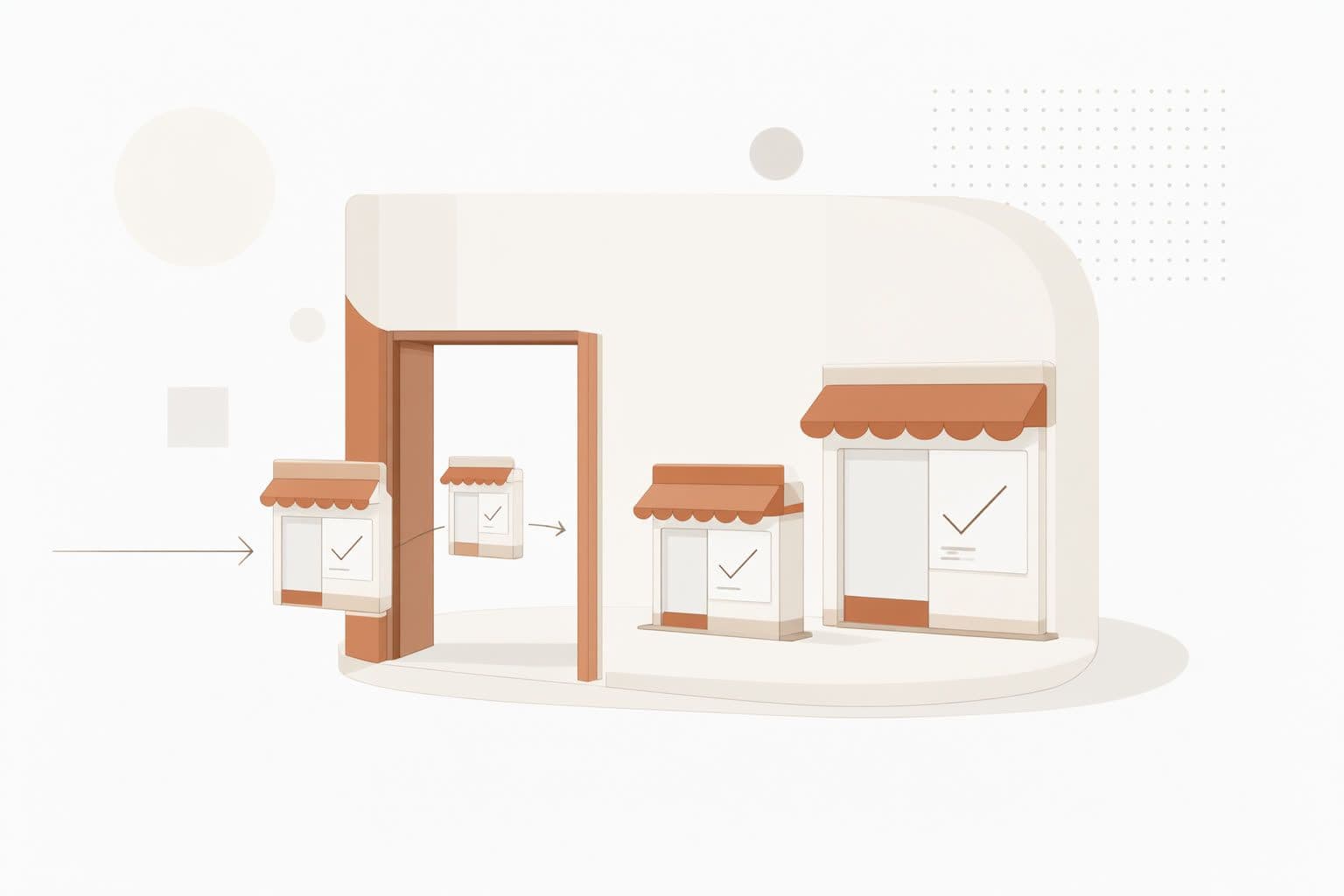
In the payfac model, the platform — say, a marketplace connecting freelancers with clients, or a booking app connecting hosts with guests — sits between its users and the underlying payment infrastructure. Instead of every seller or host applying for a merchant account of their own, the platform holds one master account and onboards each user as a sub-merchant underneath it.
The platform takes on the onboarding itself: collecting basic business details from each sub-merchant, running lightweight checks, and activating payment acceptance, often within minutes. Funds from a sub-merchant's sale flow into the master account first, and the platform is then responsible for splitting and paying out each sub-merchant's share, typically on an automated payout schedule.
This is a meaningful step up from a simple aggregator relationship: the platform is not just a payments customer, it takes on real operational responsibility for its own users — onboarding, monitoring for fraud, and keeping funds properly separated. In return, the platform can offer a smooth, in-product payment experience and often keep a small margin on the payment flow as part of its own monetisation.
Payment facilitator vs payment aggregator vs PSP vs merchant acquirer
With four similar-sounding terms floating around, it helps to place each one precisely.
A merchant acquirer is the bank or licensed institution that holds the relationship with card networks and ultimately settles funds. It sits underneath everything else in this list.
A payment aggregator is the model where one master merchant account, held with an acquirer, is shared across many sub-merchants — usually run by a payments company that lets individual businesses sign up directly and start accepting payments in minutes.
A payment service provider (PSP) is the broader umbrella term for a company that gives businesses the tools to accept and manage payments across channels — a PSP might run an aggregator model, hold individual merchant accounts for its customers, or both.
A payment facilitator (payfac) is what a software platform becomes when it adopts the aggregator model for its own users rather than for itself. Instead of a payments company onboarding individual businesses, a marketplace, SaaS product or app onboards its own sellers, hosts or clients as sub-merchants — usually by building on a PSP's API rather than arranging acquiring relationships from scratch.
Put simply: the acquirer settles the money, the PSP or aggregator gives a business a way to accept it, and the payfac is a platform extending that same ability to its own users.
Who becomes a payment facilitator, and why
Becoming a payfac makes sense for platforms that connect many independent sellers, providers or hosts with customers — marketplaces, booking platforms, field-service software, and SaaS tools used by freelancers or small businesses. If your product already has "one-to-many" users who each need to get paid, embedding payment facilitation keeps them inside your product instead of sending them off to sign up with a separate provider.
The benefits are real: a smoother, branded checkout experience, one integrated view of transactions across every user, and the option to add a margin on payment volume as a new revenue line. It also removes friction at the exact moment a new seller or host joins your platform — the faster they can start getting paid, the sooner they start transacting.
The trade-off is responsibility. A payfac takes on ongoing obligations around onboarding checks, transaction monitoring and payout accuracy for every sub-merchant on its platform. That's why most platforms build on top of an existing PSP's infrastructure and API rather than becoming a payfac from a blank slate.
Where one.ooo fits
one.ooo is built as an all-in-one, cost-effective payments platform: omni-channel acceptance across online checkout, payment links and in-person POS, plus multi-currency accounts across 13 currencies, all through a single dashboard. Most Singapore businesses use one.ooo the direct way — sign up, connect a bank account, and start accepting Visa, Mastercard, Amex, JCB, UnionPay, Apple Pay, Google Pay and PayNow — without needing to think about payfac or aggregator terminology at all.
If you're building a platform of your own — a marketplace, a booking product, a vertical SaaS tool — one.ooo's REST API and embedded finance capabilities let you extend payment acceptance to your own users directly inside your product, with batch payouts to split funds between sellers, hosts or clients. That's the practical route most platforms take toward the payfac model: build on an existing PSP's onboarding and API rather than negotiating acquiring relationships from the ground up.
Either way, the goal is the same: simplify payments so you spend less time managing infrastructure and more time on your product.
Important Information
ONE Payments Pte. Ltd. (UEN 202324291R) is registered in Singapore and operates as a technology and merchant services platform. The platform, dashboard, API and embedded finance capabilities described on this page are provided by ONE Payments; payment processing, fund holding and settlement of regulated payment activities are carried out by the licensed regulated partner named above. Information on this page is provided for general guidance only and does not constitute financial, legal or regulatory advice. Please confirm the latest pricing and available services when onboarding. Contact the ONE Payments team for details.