
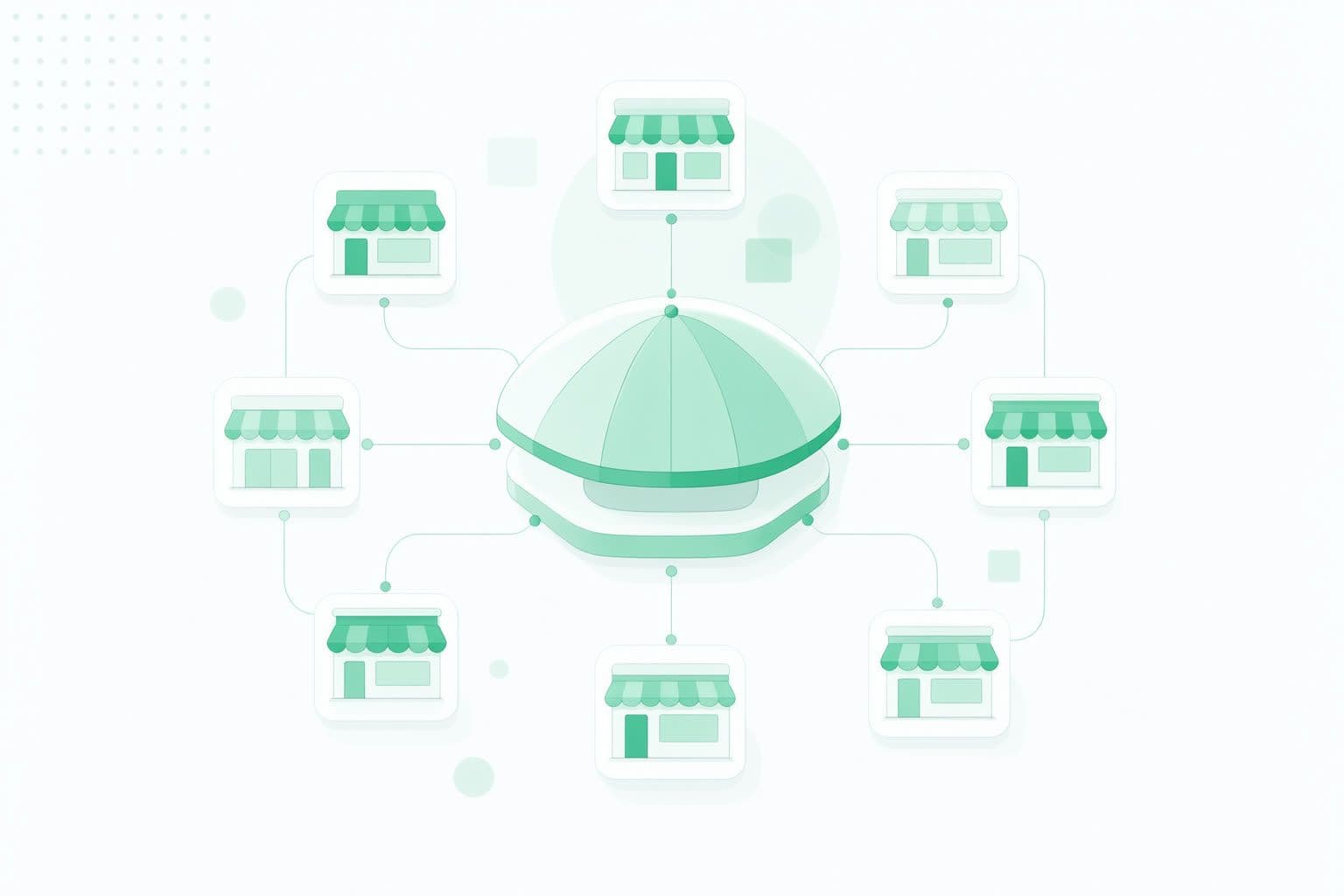
How a payment aggregator works
In a traditional setup, a business that wants to accept card payments applies directly to an acquiring bank. The bank runs a credit check, reviews the business model, negotiates rates and — if approved — issues a unique merchant ID (MID). That process can take days or weeks and is often out of reach for new or micro businesses.
A payment aggregator reverses this. The aggregator holds one master MID with the acquiring bank and then onboards sub-merchants underneath it. When you sign up as a sub-merchant, you get access to payment acceptance immediately because the aggregator has already completed the compliance and underwriting on your behalf at the aggregate level.
Funds from your customers flow to the aggregator first, then the aggregator sweeps your share into your account on a regular settlement schedule. In exchange for this simplicity, the aggregator takes on risk management centrally — monitoring for fraud and chargebacks across the whole portfolio — and passes that cost through in its pricing. For most small and growing businesses, the speed and simplicity of the aggregator model far outweigh the slightly higher per-transaction cost compared to a direct acquiring relationship.
Payment aggregator vs merchant account vs PSP
The terms payment aggregator, merchant account and payment service provider (PSP) are often used loosely, so it helps to be precise. A merchant account is a dedicated bank account issued directly to your business by an acquirer. It gives you your own MID, typically a negotiated rate tied to your specific risk profile, and direct settlement — but it requires a formal application and ongoing compliance. Larger or higher-volume businesses usually end up here once they outgrow a shared arrangement.
A PSP is a broader term: it describes a company that provides payment processing services, which may or may not include the aggregator model. Some PSPs issue individual merchant accounts; others aggregate. The distinction matters when you are evaluating contracts — an individual merchant account means your rate and reserve terms are specific to you, while an aggregated account means you share risk pooling with other merchants under the same master ID.
A payment aggregator is specifically the sub-merchant model described above. The practical differences for an SME come down to three things: onboarding speed (aggregator wins), pricing flexibility (merchant account wins at scale), and ongoing compliance burden (aggregator absorbs most of it on your behalf).
Benefits of the aggregator model for SMEs
For small and medium businesses, the aggregator model solves several real problems at once. First, fast onboarding: instead of waiting weeks for bank approval, most aggregator sign-ups complete in minutes. You can start accepting Visa, Mastercard, American Express, JCB, UnionPay, Apple Pay, Google Pay and PayNow under one contract, without negotiating separately with each card network.
Second, a single contract: rather than managing relationships with an acquirer, a gateway provider and a separate fraud tool, you deal with one platform. That simplifies accounting, support and reconciliation. One dashboard shows every transaction across every payment method.
Third, no setup or monthly fees: with one.ooo, domestic card payments cost 2.7% plus USD 0.50 per transaction and there is no fee to get started. You only pay when you get paid, which keeps costs aligned with revenue.
Fourth, built-in compliance: the aggregator handles PCI-DSS scope for the payment infrastructure, which reduces the compliance burden on your business. You still need to follow data-handling rules, but the heavy lifting of securing card data in transit sits with the platform.
For businesses processing meaningful volume, volume discounts are available — making the aggregator model viable well beyond the startup phase.
Where one.ooo fits as an all-in-one platform
one.ooo is built on the aggregator model but extends it into an all-in-one payments platform for Singapore businesses. In addition to the fast sub-merchant onboarding typical of an aggregator, you get online payments via hosted checkout, payment links and a REST API; in-person POS hardware for brick-and-mortar sales; and multi-currency account management across 13 currencies including SGD, USD, EUR, GBP, AUD, HKD and JPY.
Payouts are handled through the same platform — you can run batch disbursements or trigger individual transfers via API, with local outgoing transfers at USD 2.00 and SWIFT international transfers at a flat USD 28.00. FX conversion, when needed, is charged at 1.00% above the interbank rate, with no hidden spread layered on top.
For platforms, marketplaces and SaaS businesses, the REST API and embedded finance capabilities mean you can extend payment acceptance to your own customers without each of them going through a separate application. This is the embedded or platform-model extension of aggregation — where you become the distributor of payment access within your own product.
Bringing online, in-person and cross-border payments under one platform is where the real simplification shows up: one login, one fee schedule, one place to reconcile. That is what all-in-one means in practice for a growing Singapore business. To compare the payment gateway layer specifically, our dedicated guide covers it in detail.
When to consider moving beyond aggregation
The aggregator model is not the right fit for every stage of a business. As your volume grows, the economics shift. A direct merchant account negotiated with an acquirer typically offers lower per-transaction rates once you are processing consistently high volumes — because you are no longer sharing a risk pool, and the acquirer can price your specific risk profile more favourably.
Transactions that are high-risk by industry classification — certain travel, subscription, or marketplace categories — may face restrictions or rolling reserves under an aggregated arrangement, whereas a direct merchant account can negotiate specific terms for your category.
That said, many businesses never need to make that switch. The convenience of a single contract, single dashboard and no monthly overhead remains valuable at mid-market volumes, especially when combined with volume discounts. The question to ask is whether the per-transaction savings from a direct acquiring relationship would exceed the operational overhead of managing a separate acquiring contract, gateway, fraud tool and reconciliation process. For most Singapore SMEs, the answer is: not until you are processing several hundred thousand dollars per month. Until then, an all-in-one aggregator platform with transparent pricing is usually the smarter choice. If you are unsure, the one.ooo team can walk through what your numbers look like at your current volume.
Important Information
Regulated payment services are provided by Airwallex (Singapore) Pte. Ltd., a MAS-licensed Major Payment Institution under the Payment Services Act 2019. ONE Payments acts as a technology provider and merchant service facilitator.
ONE Payments Pte. Ltd. (UEN 202324291R) is registered in Singapore and operates as a technology and merchant services platform. The aggregator-model capabilities, dashboard and integrations described on this page are provided by ONE Payments; payment processing, fund holding and settlement of regulated payment activities are carried out by the licensed regulated partner named above. Information on this page is provided for general guidance only and does not constitute financial, legal or regulatory advice. Please confirm the latest pricing and available services when onboarding. Contact the ONE Payments team for details.