
The cost of disconnected sales channels
Running separate systems for online and in-store payments is not just inconvenient — it quietly costs more than most businesses realise. You pay for two (or more) providers, manage two fee schedules, and spend real time each week trying to match sales from different systems against a single bank settlement.
Fragmented reporting is the most visible symptom. When a customer buys online and returns in-store, or when you want to compare channel performance for a single week, disconnected tools make straightforward questions hard to answer. You might also find that each provider handles refunds, disputes and settlements differently, adding another layer of complexity.
There is also a business risk: gaps between systems mean mistakes — a refund processed in one place that does not automatically update another, or end-of-day figures that need manual adjustment before you can close the books. Bringing both channels onto one all-in-one platform removes that overhead and gives you one reliable source of truth for every transaction.
One platform for online and in-store
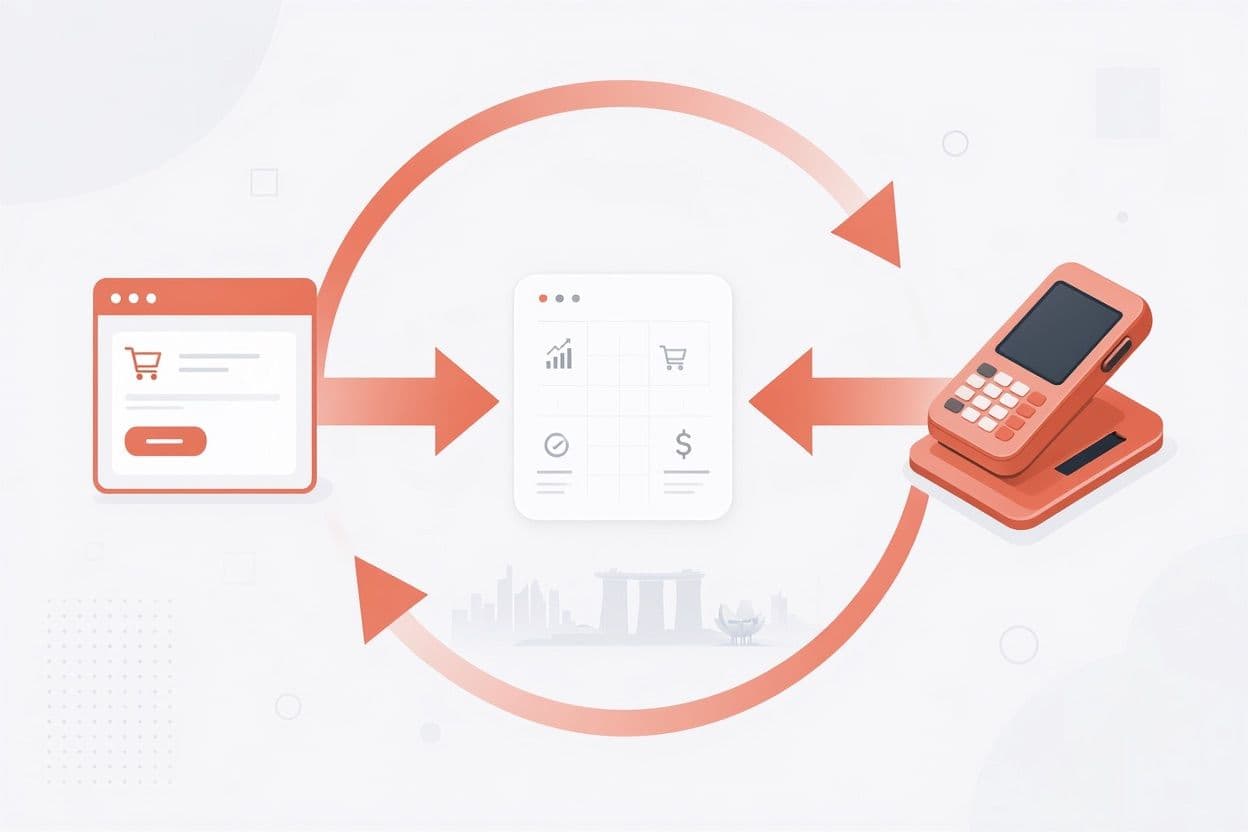
An omni-channel payment platform connects your sales channels at the infrastructure level, not just at the reporting layer. With one.ooo, the same merchant account handles your online checkout and your in-store POS terminals. That means one onboarding process, one set of pricing, one team to contact if something needs attention.
For online payments, you can accept all major card brands — Visa, Mastercard, American Express, JCB and UnionPay — plus Apple Pay, Google Pay and PayNow. You can also send payment links to customers, use a hosted checkout page, or connect via the REST API if you have a developer building a custom flow. For in-store payments in Singapore, POS terminals accept credit and debit cards, NFC contactless payments and QR-code wallets. All activity from every channel flows into the same system, so your reconciliation is a matter of reviewing one report rather than chasing several.
For businesses that process meaningful volume, volume discounts are available — it is worth talking to the team as you scale. You can also explore Choosing a payment gateway in Singapore for more background on the online side.
Accepting in-store payments in Singapore
For physical retail, restaurants, events and any business with a customer-facing counter, POS terminals are the practical heart of an in-store setup. one.ooo offers POS terminals in Singapore that accept credit and debit cards, NFC contactless payments — so customers can tap a phone or a wearable — and QR-code wallets, which are increasingly common among local shoppers.
Hardware is available to purchase outright or to rent, giving you flexibility depending on whether you want a capital buy or an operating expense. A rented terminal is practical if you are testing a new location or running a short-term pop-up; purchasing makes sense for an established counter where the terminal will see daily use.
Because the terminals connect to the same one.ooo platform as your online checkout, every in-store transaction appears alongside your digital sales in the same dashboard. There is no manual import, no separate login and no end-of-day file transfer to manage — the data simply flows through.
Accepting payments online
Your online payment setup should match how your customers want to pay without adding complexity on your side. With one.ooo, a single integration covers all the main methods: Visa, Mastercard, American Express, JCB and UnionPay for card-paying customers; Apple Pay and Google Pay for shoppers who prefer to pay with a stored card on their phone; and PayNow for customers who want to pay directly from their Singapore banking app.
Beyond the checkout itself, you can also send payment links — useful for invoices, social commerce and any situation where a customer is not on your website. The hosted checkout option lets you accept payments without building a payment form yourself, while the REST API gives developers full control to embed payments into a custom application or platform.
One dashboard across every channel
The practical value of an omni-channel platform comes through most clearly in day-to-day operations. With all transactions — online, in-store, payment links and API-triggered — flowing into one dashboard, your reporting is a single view rather than a patchwork of exports.
Reconciliation becomes straightforward: you can filter by channel, by date, by payment method or by currency and get a clean picture of what came in and what it cost. Refunds and disputes are handled in the same place as sales, so there is no separate portal to check. If you handle payouts — disbursements to suppliers, partners or contractors — batch payouts and API-triggered disbursements are available from the same platform.
For businesses holding funds in multiple currencies, the business account supports 13 currencies: SGD, USD, AUD, CAD, CHF, CNY, EUR, GBP, HKD, JPY, NOK, NZD and SEK. That means you can receive, hold and pay out in the currencies your business actually uses, with FX conversion happening on your terms rather than automatically at every step. A unified view across every channel and currency is where the real benefit of an all-in-one approach shows up. Talk to the one.ooo team to see how it fits your specific setup.
Important Information
ONE Payments Pte. Ltd. (UEN 202324291R) is registered in Singapore and operates as a technology and merchant services platform. The omni-channel payment acceptance capabilities described on this page — including online checkout, in-store POS terminals, payment links and unified reporting — are provided by ONE Payments. Payment processing, fund holding and settlement of regulated payment activities are carried out by the licensed regulated partner named above. Information on this page is provided for general guidance only and does not constitute financial, legal or regulatory advice. Fees quoted are current at the time of writing — please confirm the latest pricing and the services available for your specific business when onboarding. For details about your setup, contact the ONE Payments team.