
What cross-border ecommerce payments actually involve
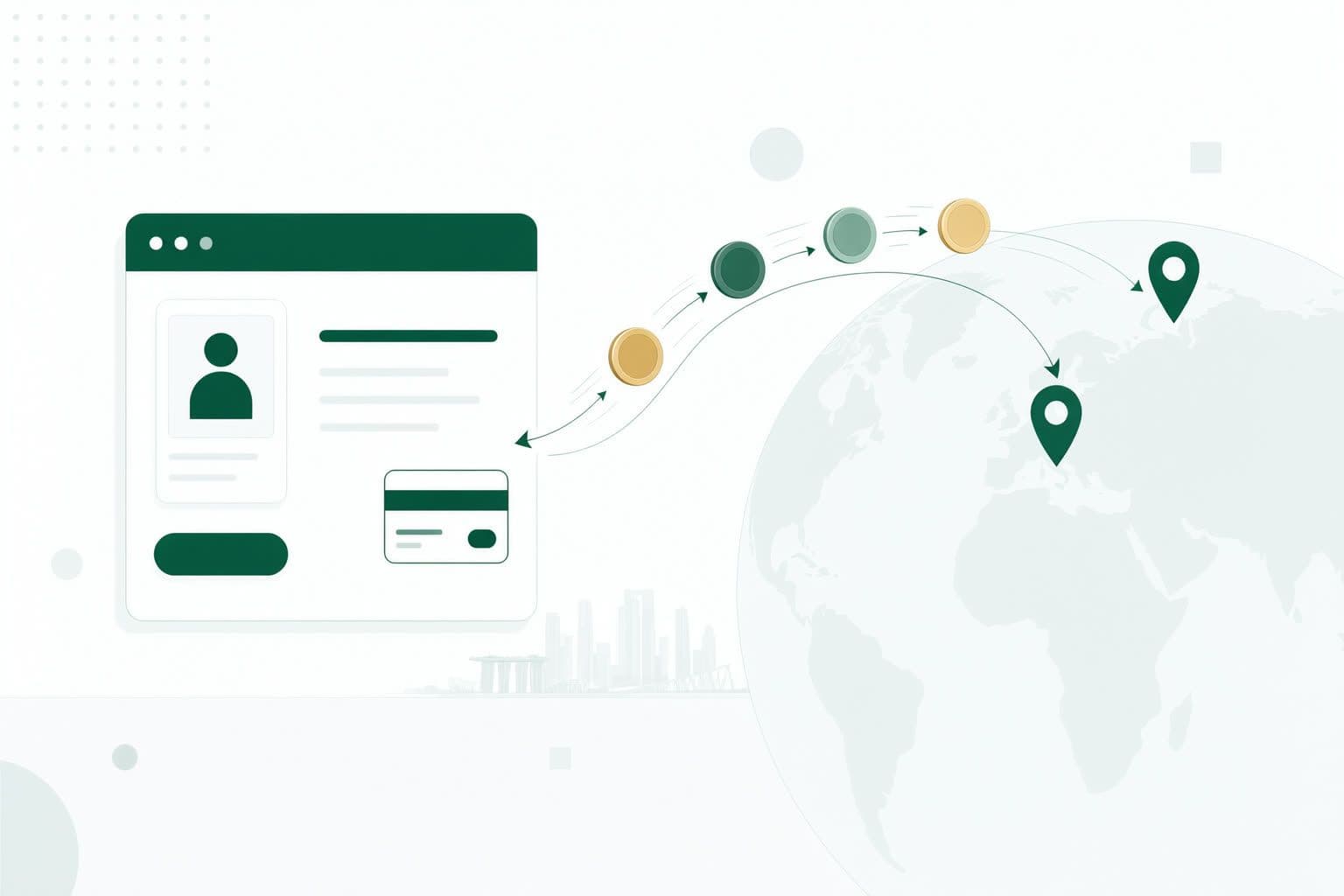
For an online store, cross-border ecommerce payments are really three separate moments stitched together: accepting a card or wallet payment from a customer in another country, deciding what currency to show and settle in, and converting that money into something your business can use day to day. Miss any one of these and the sale gets harder — a shopper who does not recognise the checkout options, a price shown in an unfamiliar currency, or an FX cost that only becomes clear after the fact.
For Singapore online stores selling into Southeast Asia, Australia, the US, the UK, or further afield, this is no longer a niche concern — it is a High-priority part of running an ecommerce business, alongside domestic sales. The goal is to make paying from abroad feel just as easy as paying from Singapore, while keeping your own reconciliation and FX simple on the back end. ONE brings the acceptance, currency holding and conversion pieces together in one platform, so an overseas sale is not a special case your team has to handle differently.
Why checkout conversion depends on payment method choice
Overseas shoppers convert less often when your checkout only recognises payment methods they do not use at home. ONE lets your store accept Visa, Mastercard, American Express, JCB and UnionPay, plus Apple Pay and Google Pay for fast mobile checkout, so shoppers from a wide range of markets see options they already trust. PayNow remains available for your local Singapore customers, so the same checkout serves both audiences without a separate setup.
You can offer this through a hosted checkout page, a shareable payment link, or a direct API integration into your own storefront — whichever matches how your store is built. Because every method runs through the same platform, an international sale looks the same in your dashboard as a domestic one: one report, one settlement view, no separate tool to check. For an ecommerce or SaaS business selling omni-channel — online, via links, and in some cases in person — that consistency is what keeps operations manageable as international volume grows.
Settling in the currencies your customers actually use
A shopper paying in their own currency tends to trust the transaction more, and a store that can hold that currency avoids converting money it does not need to convert yet. ONE's multi-currency account lets you hold and settle in 13 currencies: SGD, USD, AUD, CAD, CHF, CNY, EUR, GBP, HKD, JPY, NOK, NZD and SEK. That covers most of the markets a Singapore ecommerce store is likely to sell into first — Australia, the US, the UK, the EU, Japan and Hong Kong among them.
Holding a balance in the currency you were paid in means you choose when to convert, rather than having conversion forced on you at the moment of sale. For a closer look at how a multi-currency account works day to day — including how balances, transfers and reporting fit together — see our guide on multi-currency accounts for Singapore businesses.
Keeping FX costs transparent from checkout to settlement
One of the top complaints about accepting international payments online is not the cost itself — it is not knowing what the cost actually is until the money lands. ONE charges international card payments at 3.4% plus USD 0.50 per transaction, with FX conversion at 1.00% above the interbank rate when a conversion is needed. Because that rate is quoted against a public reference point rather than an internal marked-up figure, it is straightforward to check what you are actually paying.
This matters most at volume. A cost-effective FX setup on a handful of overseas sales a month is barely noticeable; the same setup across hundreds of international orders either protects your margin or quietly erodes it. Local transfers out, once funds are converted, cost a flat USD 2.00, and SWIFT remains available for destinations without local rails — though for most ecommerce stores, the acceptance and FX side of checkout matters far more day to day than outbound transfer rails.
Reducing cart abandonment for overseas shoppers
Cart abandonment tends to spike at exactly the moments described above: an unrecognised payment method, a price in an unfamiliar currency, or a checkout that redirects somewhere that looks unfamiliar or slow. None of these are dramatic problems on their own, but together they add enough hesitation for a shopper to close the tab.
The practical fix is to simplify payments at the point where the shopper is deciding whether to trust you: offer the card brands and wallets they already use, keep the checkout fast whether it is hosted, a payment link, or embedded via API, and make sure a failed or delayed payment does not require the customer to start over. Because ONE handles domestic and international payments through the same underlying platform, your team is not maintaining two checkout experiences — one for local shoppers and one, often clunkier, bolted on for everyone else.
Bringing it together: one platform for global ecommerce sales
The real advantage of an all-in-one setup is not any single feature — it is not needing a separate provider for acceptance, another for holding foreign currency, and a third for converting and moving money out. With ONE, an ecommerce store selling internationally handles all of it through one dashboard: card and wallet acceptance, a 13-currency account, and transparent FX, with a single view of revenue whether the sale came from Singapore or overseas.
As your international order volume grows, this consolidation is what keeps reconciliation manageable and your reported margin accurate. If you are scaling cross-border ecommerce sales and want to see how the acceptance and currency side fits together for your specific store, talk to the ONE team about your setup, or read how the checkout and payment method side works in more depth in our guide to accepting online payments.
Important Information
ONE Payments Pte. Ltd. (UEN 202324291R) is registered in Singapore and operates as a technology and merchant services platform. The multi-currency checkout, settlement and payout capabilities described on this page — multi-currency accounts, card acceptance, FX conversion and international transfers — are provided by ONE Payments. Payment processing, fund holding and settlement of regulated payment activities are carried out by the licensed regulated partner named above. Information on this page is provided for general guidance only and does not constitute financial, legal or regulatory advice. Fees quoted are current at the time of writing — please confirm the latest pricing and services available for your specific business when onboarding. Contact the ONE Payments team for details about your setup.